
INTRODUCTION
It is no longer enough for museums to keep a majority of their collection in storage solely for future generations. As the Museums Association (Cross and Wilkinson, 2007:18) stated in their ‘Making Collections Effective’ report, “It is becoming increasingly difficult to justify spending public money caring for public resources whose potential is never seen to be realised”. As the public becomes more aware of the fact that most museum’s collections are in storage, museums are feeling the urgency to make better use of their collections. There are a variety of methods that museums have already employed to work towards this goal. The methods discussed here focus particularly on active loaning, open storage, and collaborating with originating communities. Loans to outside institutions bring more visibility to objects in storage and have the potential to strengthen source community focused exhibitions. Open storage creates a multi-purpose resource for groups ranging from academics, artists, the general public, and indigenous peoples. Seeking out reciprocal relationships with the originating communities of objects allows for enhanced interpretation of artefacts and new knowledge to be gained relating to a collection. In approaches focused on opening up a collection to travel, visibility, and outside input, museums not only gain enhanced records and further use of their collections, they also make their collections more transparent and gradually decolonised in the process.
OVERVIEW
Thousands, and in some cases millions, of artefacts are held behind closed doors in the storage of museums. These objects are proclaimed by museums to be public resources, yet in reality gaining access is often limited, and so stored museum collections typically remain utilised by a select few academics and museum researchers (Cross and Wilkinson, 2007). In the past this was an acceptable mode of operation, but in the current world economy this has become something that is no longer enough to validate the large sums of money spent on maintaining such storage (Wilkinson, 2005). It is now the time to truly open up collection access to the wider public and to people from source communities of the objects held in museums.
To put things lightly, people belonging to source communities have not had a good relationship with the museum sector over the past few hundred years. Within museums, indigenous minorities have historically had their stories overridden or completely ignored in favour of narratives told by predominantly white colonisers (Koshy, 20018; Honarbakhsh et al., 2011). This latter demographic often cared little about the people whose objects they carted off back to Europe. As a result, museums are a hotbed for artefacts with little to no information on their true origins or purpose (Koshy, 2018). In recent years both museums and the public have become more acutely aware of collection origins and have been calling for a change, specifically for the decolonisation of museums. At the foundational level this means changing the narrative of exhibits, collections, or objects to one that is told instead by those who are members of source communities. It can mean involving local communities in the process of deciding if, or how, an object is displayed, and can extend to the repatriation of objects (Koshy, 2018). Ultimately, decolonisation calls for museums to loosen their grip on their own power and open their doors to collaboration with people from source communities. A more balanced relationship between museums and source communities has shown to bring huge benefits to the relevancy and effectiveness of a collection. This in turn provides a chance for a reclamation of the historical narrative by originating communities. In the following sections, museums practicing active loaning, open storage, and collaboration with originating communities will be discussed with a focus on how they are both making their collections more effective according to Museums Association standards and subsequently practicing decolonisation of their museums in the process.
METHODS
(Skips to third method)
Active Engagement/Collaborations with Originating Communities
As was demonstrated with the British Museum loan, collaboration with outside organisations and communities can lead to enhanced knowledge of a collection and strengthened bonds with originating communities. Further strategies leading to similar ends are consulting with originating communities for collection reviews and allowing them hands-on interactions with objects from their past.
In their 2005 ‘Collecting for the Future’ report, the MA found there is a lack of museum staff in the UK with the expertise needed to develop their collection. They go on to suggest that “capturing the richer stories and more detailed knowledge about key artefacts might be a more pressing need than completing the documentation of entire collections at object level” (Wilkinson, 2005:20). This idea should be prioritised by museums so that situations arising like that at the Pitt Rivers Museum in Oxford, can happen less. After visiting the museum, Maasai tribes-person and activist Samwel Nagiria initiated contact with the Pitt Rivers director when he noticed an object from his own culture “poorly described, with a lack of what the object is meant for [and its] cultural significance” (Koshy, 2018). Not long after, a group of Maasai traveled to the museum to inspect the collection and make additions and corrections to the records. This collaboration allowed for the Maasai people to reclaim a part of their history while also enhancing the museums knowledge on their objects for future display and exhibits, but it is a situation where the museum ultimately should have sought out input first.
Reaching out to originating communities has shown to bring a richness to objects that they were previously lacking. A step even further in the direction of the revitalisation of objects is seen in museums facilitating the use of objects in learning and ceremonial or ritual purposes by source people. The Museum of Anthropology in British Columbia not only sees this as something to enhance the use of their collection, but treat it as integral to the “long-term cultural preservation of the objects and to the museum as a whole” (Honarbakhsh et al., 2011:68). In 2009 weavers from the Nuu-chah-nulth people requested to work with a selection of baskets to better learn about past weaving techniques in their community (Honarbakhsh et al., 2011). They were given access to the objects, instructed on handling techniques, and were ultimately permitted to choose if they wanted to wear protective gloves during their handling session. Having access to the objects and the freedom to choose how to handle them created what was described as a “jovial atmosphere”. Relaxing handling rules and giving free access allowed the community to create deeper connections with the objects and their own past.
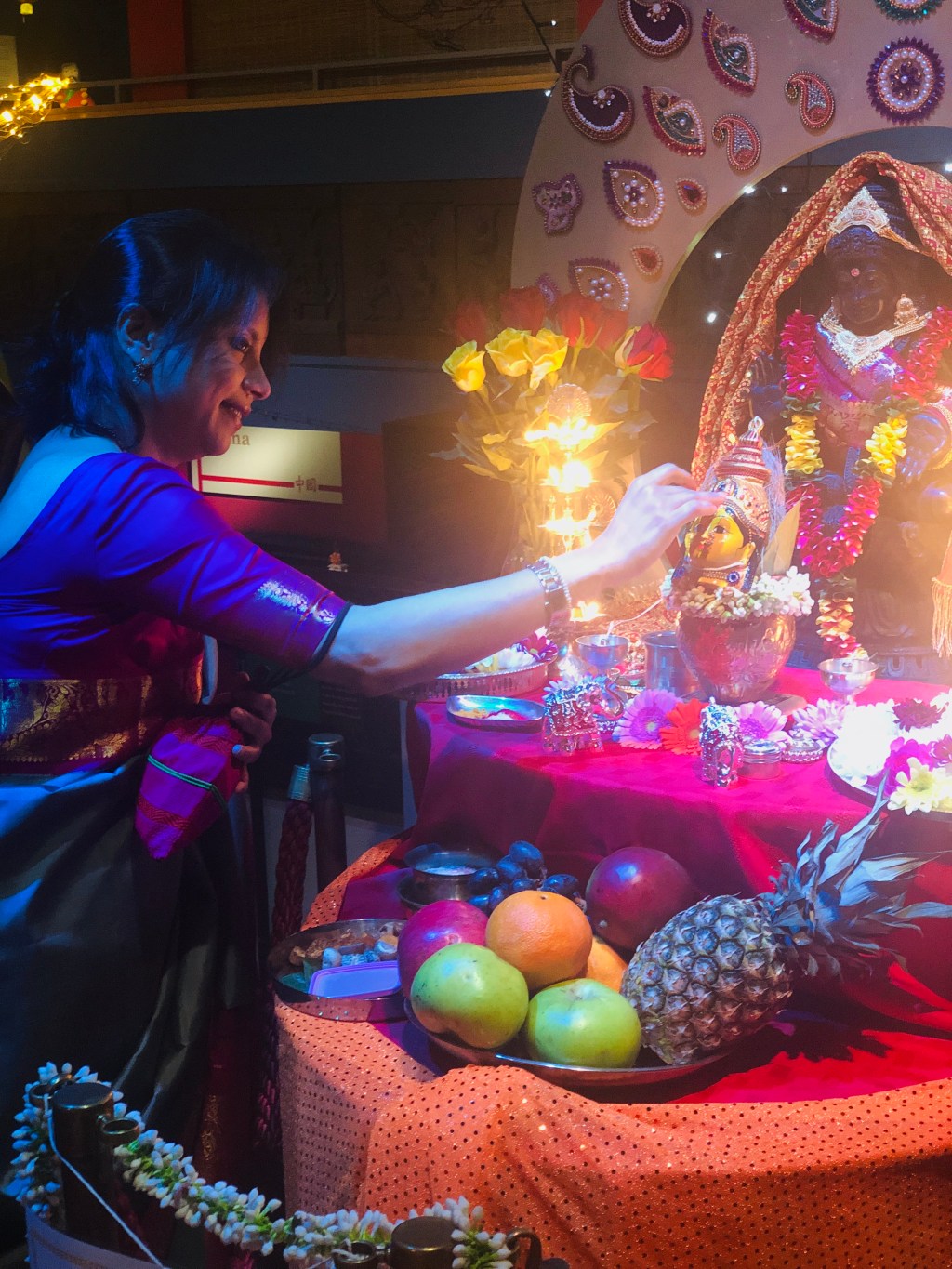
Another example of a museum allowing use of an object by a community is at the Oriental Museum in Durham, England. A bronze statue of the goddess Lakshmi has been used in recent years by the local Hindu community for the Diwali festival of lights, taking place at the museum itself. The statue is surrounded with flowers, herbs and spices, and is anointed with organic substances. Hundreds of Hindu and non-Hindu people attend this event, bringing visibility to Hindu practices and the material culture connected to it within the museum. An event such as this with an object from the collection at the center sends a message to those who attend. A message that this space is not just for artefacts and academics, but is also for them as people and for their community. With an event like Diwali being held at the museum and conducted by local Hindus, the space is transformed into a place where a culture’s objects and practices are embraced all at once.
The foremost concern with the last two approaches is that of the conservation of the objects involved. Each museum discussed has developed their own approach to this based on their museum’s aims and philosophies. At the MOA they have chosen to approach the care of their objects as a collaborative effort between the museum conservators and the source communities (Honarbakhsh et al., 2011:70). During the basket handling session the level of risk to the objects was higher than usual, but they were willing to take such risks with the benefits sitting heavily as a reason to move forward. When making a decision in regards to allowing a museum object to be used during a ritual as the Oriental Museum does, it is important to consider the aspects of an object that are not inherent to its physical form. Objects had a purpose and a life before they came to be in a museum. They had their own identities and they helped to form the identities of the people who owned or utilised them. The act of placing objects into a museum essentially ‘deactivates’ this intangible aspect of an object. Thus, the occasional handling of museum objects gives an opportunity for the cultural revitalisation of an object; which is of benefit to the museum, the public, and the originating communities.
 SHELBY NAVONE