
This research was published in the 2022 volume of the Durham Archaeological Journal and was the winner of the 2022 Geoff Egan Prize.
The article is Open Access and available in full here.
Report Layout Sample
OVERVIEW
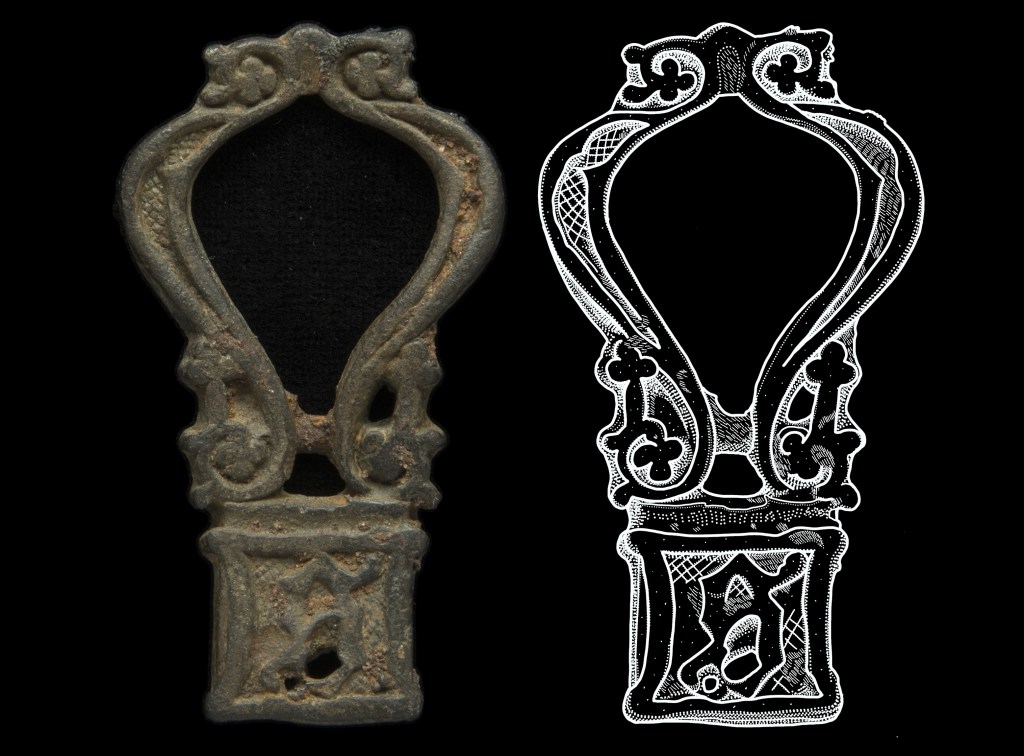
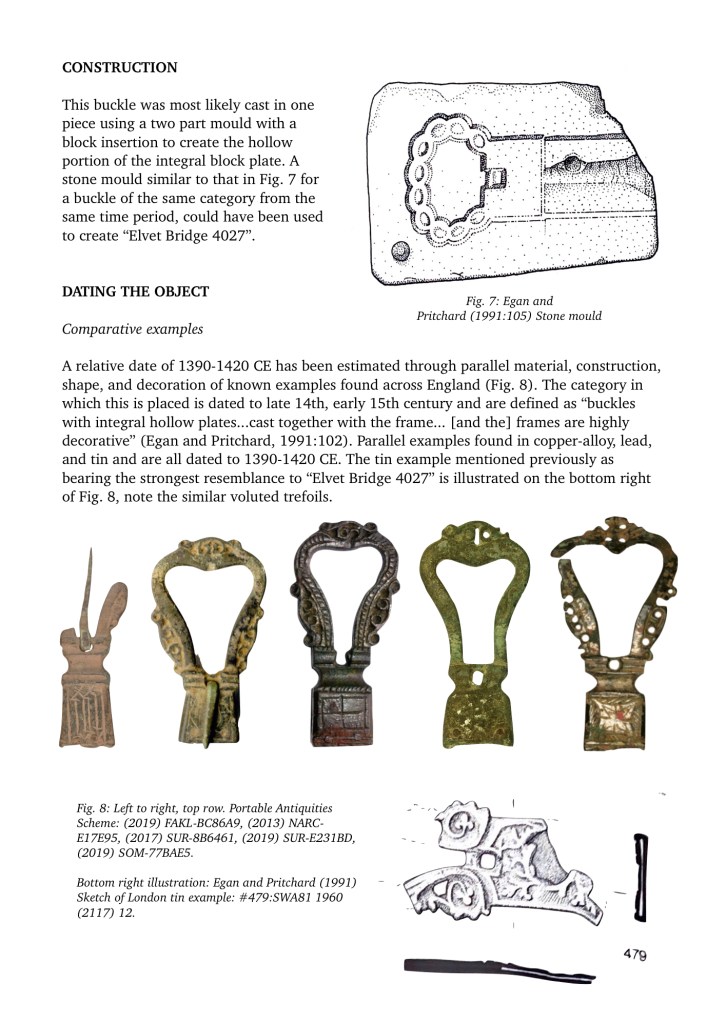
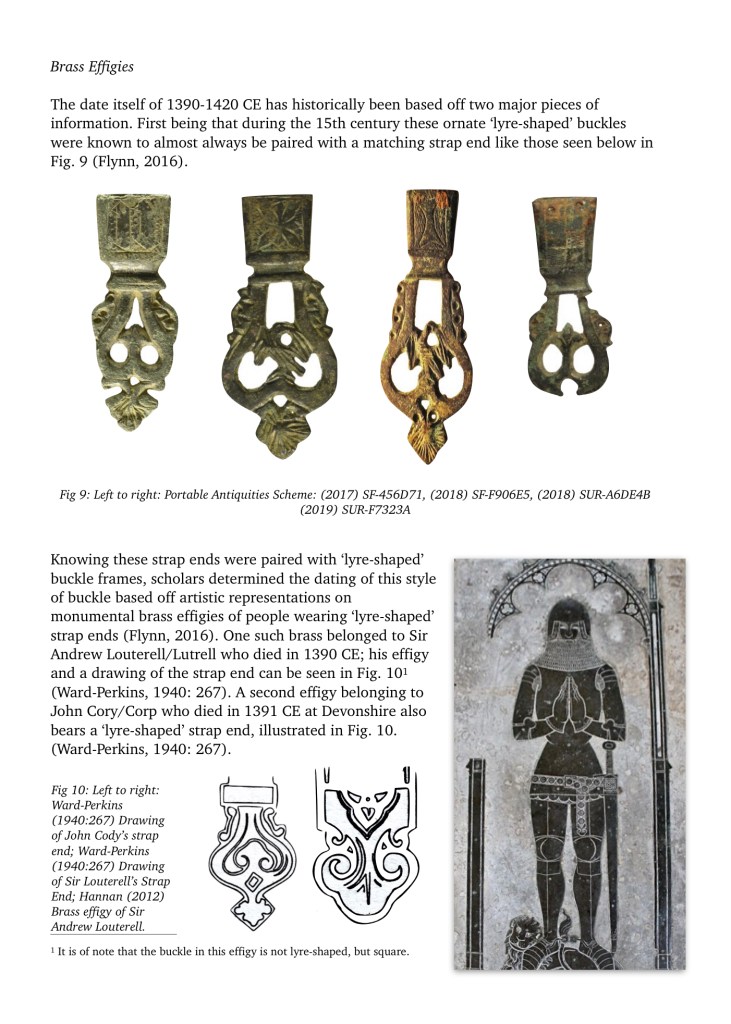
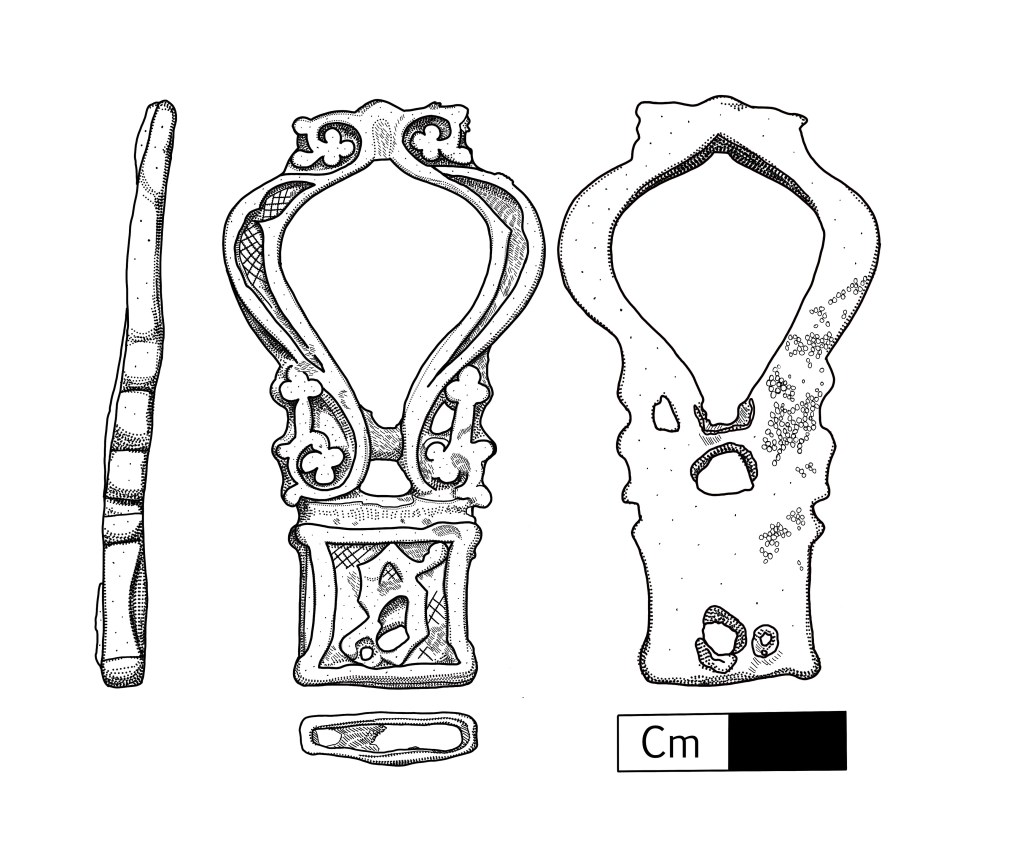
Artefact “Elvet Bridge 4027” had not previously been identified in its function before this report. Through comparative studies of this artefact it has been designated as a buckle. Non-invasive X-ray fluorescence (XRF) analysis was performed on the object to determine its surface elemental composition as tin (Sn). In regards to what material the buckles core was cast from, arguments can be made for both tin or a copper-alloy, and so evidence towards both will be given. The parts of and methods used for the artefact’s construction will be explored in the context of medieval industries in England. Dating the object to 1390-1420 CE was concluded by comparison with dated specimens found throughout England that are parallel in shape, decoration, and possibly material. This date was further corroborated by comparison to medieval brass effigies as well as the style of calligraphy used in the raised letter ‘s’ detail. Additionally, the significance of the decorative elements present in the buckle will be analysed through the lens of early 15th century English society. Finally, possibilities of who this object may have formerly belonged to will be discussed.
REGIONAL CONTEXT – FIND SITE
“Elvet Bridge 4027” was recovered from the River Wear in Durham, England near Elvet Bridge by Gary Bankhead on May 19th 2012. A possible explanation for this artefact ending up in the river has been given by Egan, who asserts that many medieval dress accessories would have been discarded “within a generation of their manufacture” if they no longer fit the fashion tastes during that time (1998:12). Additionally, if this object was of any religious significance its deposition in the River Wear could also be possibly be linked to Christian pilgrimage practices (Durham University Archaeology Department, 2020). Durham was an important religious and political site in the Medieval period with its towering cathedral and shrine to Saint Cuthbert (Aalen, 2006: 158). The city developed around the central cathedral and castle, but the only marketplace remained in the centre of the city in the Bishops borough (Aalen, 2006:158). Elvet Bridge, built in 1180 CE, connected this market to the “hinterland to the east… thus establishing Durham as the crossroads of the country” (Aalen, 2006: 158).
MATERIALS
A variety of materials were used to cast buckles during the Medieval era in England. Copper, iron, and lead/tin were utilised and blended in varying degrees from 1150-1450 CE; copper and iron being the most common up until the 1400’s when lead/tin buckles are found in the larger quantities (Egan and Pritchard, 1991:21). This archaeological data is in line with various charters put forth by the London Girlder’s Guild in 1321 CE, and again in 1344 CE, which essentially outlawed buckles and mounts with “false work, such as lead, pewter and tin, and other false things” (Egan and Pritchard, 1991:21). Later a statute in 1391 CE relaxed these rules, “recognising that these metals had been in use for some time, and sought to ease the restrictions”, and so buckles and mounts made of non-ferrous white metals began to quickly infiltrate the market (Egan and Pritchard, 1991:21). This historical context is important to consider when attempting to determine the metal which “Elvet Bridge 4027” is primarily comprised from.
 SHELBY NAVONE
Leave a comment